Culture, space and participation
Accessibility in museums and exhibitions: what to consider in planning?
From arrival to contact with the works, see how to coordinate the route, exhibition, orientation and communication resources to increase visitor participation.
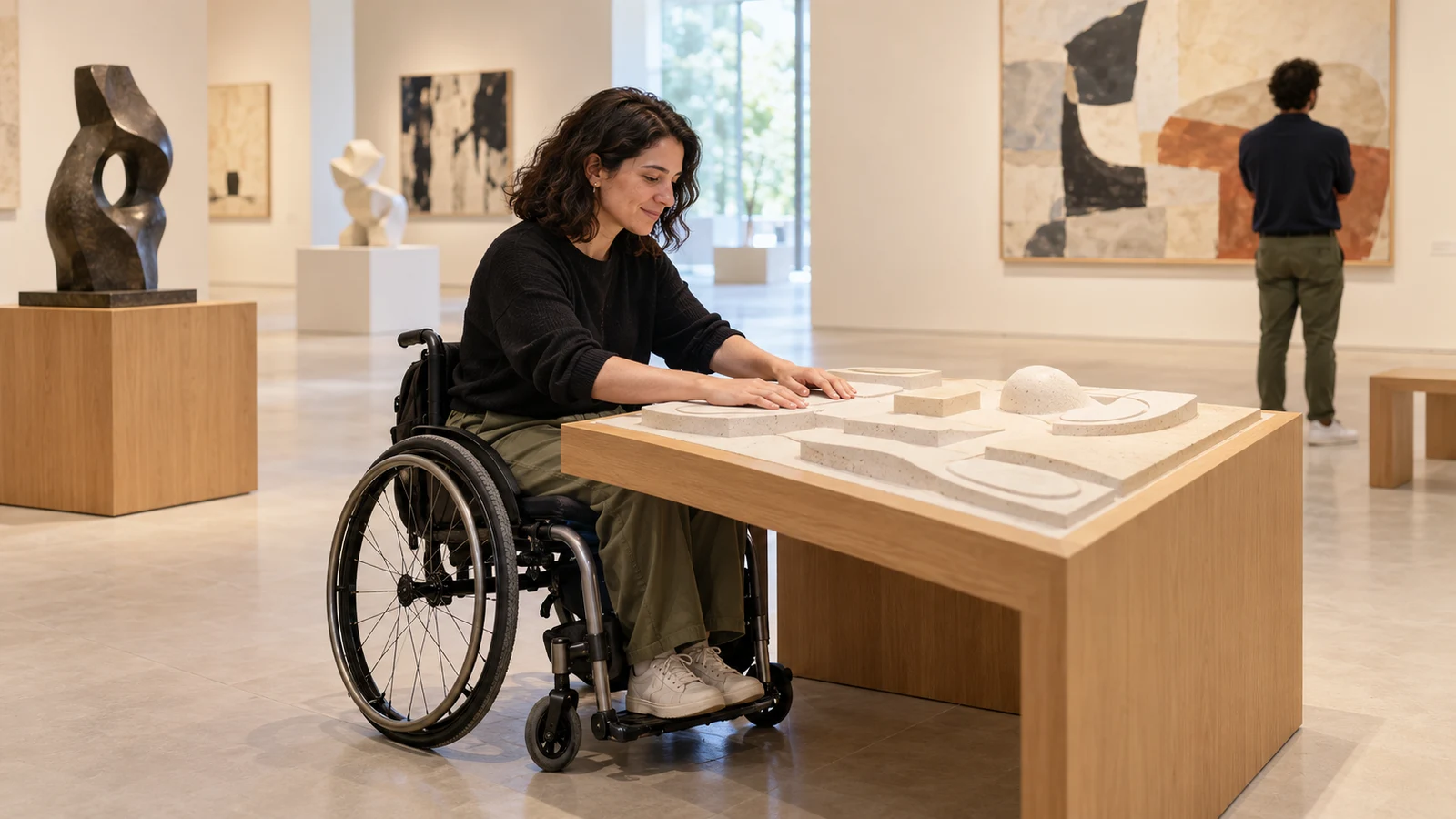
Planning accessibility in museums requires connecting access to the building, circulation, proximity to the works and understanding of the content. Solutions need to consider different audiences, the curatorial proposal and the real conditions of the space. Architecture, expography, communication and service must be worked together.
How to start planning an accessible exhibition?
Gather the space team, curation, production, educational and accessibility professionals before finalizing the layout. Identify the planned activities and barriers that may make the visit difficult.
O Ibermuseus Self-Diagnosis System addresses dimensions such as building, exhibitions, communication, safety and management. It is a reference for organizing institutional reflection, without replacing necessary surveys and projects.
Listening to people with disabilities helps identify difficulties that an analysis based solely on drawings may not reveal. This participation must complement the technical work, not transfer the responsibility for resolving barriers to the visitor.
The visit begins before the first artwork
Consider how the public arrives, finds the entrance, receives information and proceeds to the exhibition. Connection to reception, restrooms, rest areas and other services is also part of the experience.
A route needs to be understandable and remain unobstructed. Queues, mobile furniture, parts under maintenance and assembly equipment can create barriers even when the initial design reserved circulation.
For example, an interactive installation may attract groups occupying the walkway. The planning must relate the area of stay in front of the work to the flow of those continuing the visit.
Inform in advance the available resources and any space limitations. This allows visitors to plan their participation without relying on generic promises that the museum is “fully accessible.”
Circulation, approach, heights and ranges
The position of a work or caption affects who can see it, read it or interact with it. The project must study the observation conditions for people sitting and standing, in addition to the approach to the exhibition elements.
Showcases, tables, panels and interactive interfaces need to be analyzed as a whole. Having an element at an apparently appropriate height does not resolve a base that impedes approach or a reflection that impairs reading.
For authorized tactile resources, evaluate range, support, identification and conditions of use. Interaction must respect the conservation of the collection: a reproduction intended for touching does not mean authorization to touch all the works.
Dimensions and details depend on the context and applicable technical standards, such as ABNT NBR 9050. This guide does not provide universal measurements or a ready-to-execute drawing.
Signage that helps you find and understand
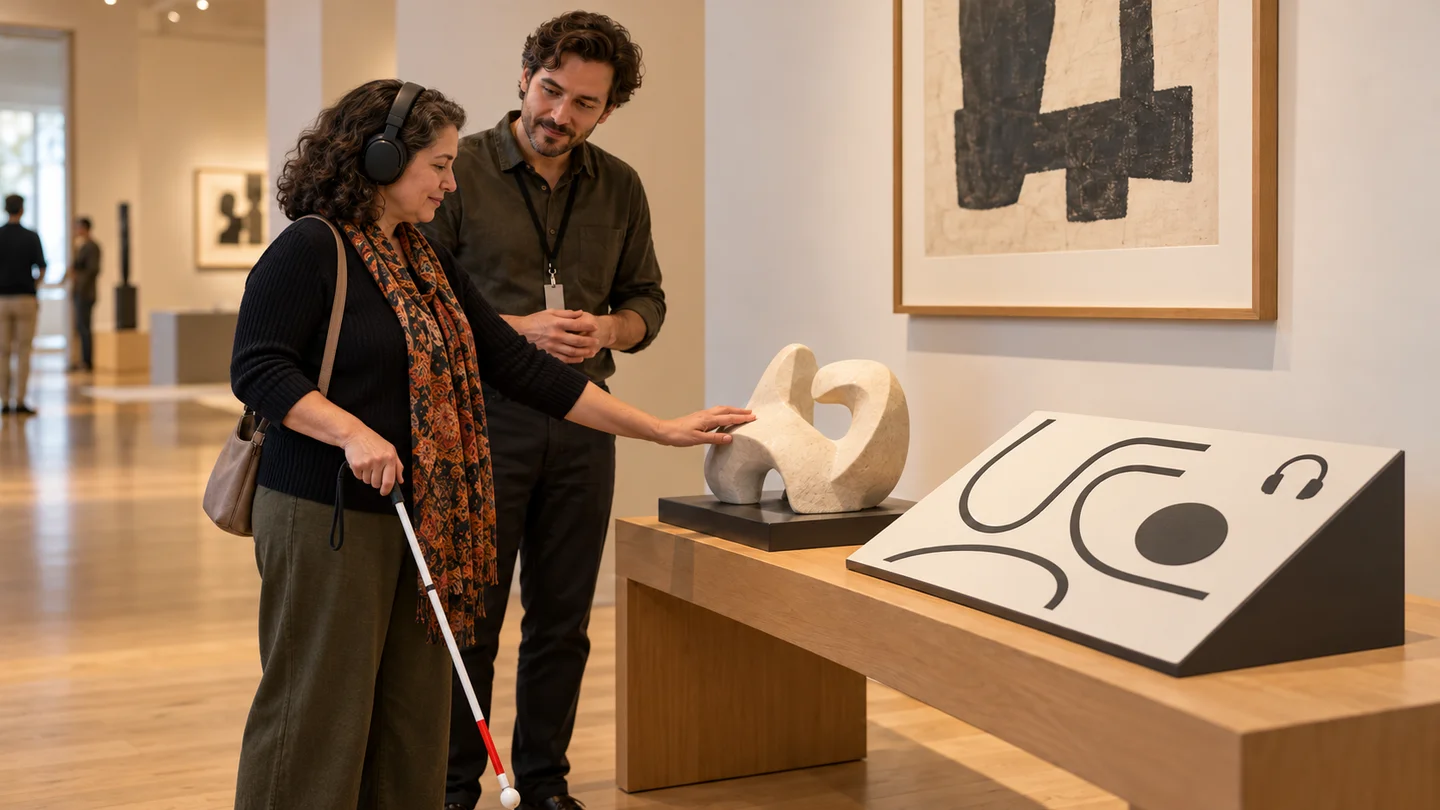
Guidance should support decisions along the way: where to enter, how to get to an environment, and what resources are available. Identification, contrast, legibility and positioning need to dialogue with the visual language of the exhibition.
Tactile and visual resources must integrate a coherent system. Installing isolated elements without evaluating the paths can produce information that is difficult to find or interpret.
Lighting, reflections and sound stimuli also deserve attention. Match conservation needs with conditions for reading, observation and sensory comfort, involving the responsible specialties.
How can tactile resources, audio description and Brazilian Sign Language work together?
Reaching a work does not guarantee understanding its content. Texts, videos, sound experiences and mediation need to consider different ways of perceiving and accessing information.
O MAM Rio describes resources such as audio description, maps and tactile pieces. The example shows integration possibilities, not a mandatory list and sufficient for any exposition.
Audio description, interpretation in Libras, production of tactile materials and other resources require professionals and their own scope. The architectural consultancy must dialogue with these teams, without assuming that all services are included.
If content is accessed via cell phone, consider how it will be found and used, including without relying on a single form of access. The service team needs to know how the resources offered work.
Check the assembly and maintain the conditions of use
Take time to check your space after installation. The final position of panels, cables, seats and supports may differ from the analyzed layout.
- Check routes and approaches to exhibition elements.
- Test reading, visibility and operation of planned resources.
- Combine responsibilities for patches and maintenance.
- Prepare the team to guide the public with respect and clarity.
- Record reported difficulties to improve the operation.
A Ibram Normative Resolution nº 30/2025 approves the Access Museums Program action plan for 2025–2029. Its approach reinforces the importance of treating accessibility as planning and management, in addition to specific adaptations.
When to hire consultancy for museums and exhibitions?
Seek support when studying a new route, reviewing an exhibition or evaluating adaptations to an existing space. The sooner issues are discussed, the more alternatives can be examined before assembly.
Send plans, site records, curatorial proposal, anticipated dates and resources. A consultancy for events and exhibitions defines analyses, projects, visits and monitoring according to contracting.
When architectural details are needed, know the accessibility project. Do not assume performance, provision or certification as part of an initial orientation.
Are you planning an exhibition?
Talk to Acessibilize about the space, the proposal and the schedule to define the necessary technical support.
Discuss your exhibition